






















X-Ray Fluorescence (XRF) is a powerful analytical technique used to determine the elemental composition of various materials. This method is both qualitative and quantitative, making it suitable for different types of materials, including solids, liquids, and powders. XRF is non-destructive, meaning the sample remains intact and free from damage after the analysis. DOT Physical exams can also complement such analytical processes in relevant fields.
Applications of X-ray Fluorescence
X-ray fluorescence (XRF) technology is utilized across a multitude of industries for its ability to accurately determine the elemental composition of various materials. The following table provides an overview of industries where XRF is commonly applied:
- Metallurgy – Identify alloys, analyze precious metals, determine coating weight and plating thickness
- Polymers – Analyze composition of plastic materials and additives
- Electronics – Inspect electronic components for compliance with material regulations
- Forensics – Examine trace elements in crime scene evidence
- Archaeology – Examine ancient artifacts and artworks for composition and provenance
- Environmental Analysis – Monitor soil and water for pollutants
- Geology – Analyze mineral samples for exploration and mining
- Mining – Determine the composition of ore samples
In each of these industries, XRF provides critical information that helps improve product quality, ensure compliance with standards, and maintain safety protocols.
Benefits of XRF Analysis
XRF analysis offers numerous benefits that make it a preferred method for material composition analysis in various sectors. Here are some of the key advantages:
- Non-destructive Testing: XRF analysis does not alter the sample being tested, allowing it to be preserved for future use.
- Speed and Efficiency: It provides rapid results, making it ideal for real-time analysis in both laboratory and field settings.
- Wide Elemental Range: XRF analyzers can detect elements from sodium (Na) to uranium (U), with Wavelength Dispersive XRF (WDXRF) extending this range down to beryllium (Be).
- Quantitative and Qualitative Analysis: XRF is effective for both identifying the presence of elements (qualitative analysis) and measuring their concentrations (quantitative analysis).
- Versatile Sample Types: Suitable for analyzing solids, liquids, and powders.
- High Sensitivity: Capable of detecting elements at concentrations ranging from 100% down to parts per million (ppm) and even sub-ppm in some cases.
- Field Usability: Handheld XRF analyzers enable on-site testing, providing flexibility and convenience.
These benefits underscore the versatility and efficiency of XRF technology, making it an indispensable tool for elemental analysis in many scientific and industrial applications.
Strengths and Limitations of XRF
Understanding the capabilities and boundaries of X-ray fluorescence (XRF) is crucial for leveraging this technology effectively. This section explores both the advantages and the limitations associated with XRF analysis.
Advantages of XRF
XRF is favored in many industries due to its numerous benefits. This non-destructive analytical technique allows for rapid and accurate elemental analysis, essential for material testing and quality control.
Key Advantages:
- Non-destructive Analysis: XRF enables the assessment of materials without causing any physical damage. This is particularly beneficial for valuable or rare samples.
- Rapid Results: The technique provides almost instantaneous data, making it ideal for on-site analysis and quick decision-making.
- Wide Range of Applications: XRF is versatile and can be used to analyze metals, minerals, ceramics, and even liquids.
- User-friendly: Modern XRF analyzers are designed to be simple to operate, requiring minimal sample preparation.
- Quantitative and Qualitative Analysis: XRF can deliver both the qualitative identification of elements and their quantitative measurement within a sample.
Limitations of XRF
Despite its numerous benefits, XRF has its challenges and constraints. Being aware of these limitations can help in making informed decisions about when and how to use XRF.
Key Limitations:
- Sensitivity to Light Elements: XRF struggles to detect light elements (such as boron, carbon, and nitrogen) due to their low energy fluorescent X-rays.
- Matrix Effects: The accuracy of XRF can be affected by the sample matrix, which can interfere with the fluorescent X-rays emitted.
- Penetration Depth: XRF primarily analyzes surface-level elements, and its efficacy decreases with depth beyond the first few micrometers.
- Sample Homogeneity: For precise results, the sample should be homogenous, which may not always be achievable in all materials.
- Radiation Safety: Although the exposure is comparable to medical X-rays, safety precautions must be taken to minimize radiation risks.
Understanding these strengths and limitations, one can effectively utilize XRF for diverse applications while being mindful of its constraints and safety requirements.
Safety Measures for XRF
Radiation Safety in XRF
X-ray fluorescence (XRF) analyzers emit a directed radiation beam during the analysis process. To ensure radiation exposure is as low as reasonably achievable (ALARA), it is crucial to observe several safety measures. Key considerations include time, distance, and shielding.
- Time: Minimize the amount of time spent near the active XRF analyzer.
- Distance: Maintain a safe distance from the XRF analyzer when it is in operation.
- Shielding: Use appropriate shielding materials to reduce exposure.
The radiation emitted from a handheld or portable XRF analyzer is comparable to the exposure received during a typical medical or dental X-ray. Despite the relatively low risk, it is critical never to point a handheld XRF analyzer at a person or any body part. Always direct the analyzer at the sample to prevent accidental radiation exposure.
Precautions in XRF Analysis
In addition to observing radiation safety measures, other precautions should be taken during XRF analysis:

Adhering to these radiation safety measures and precautions, the use of XRF analyzers can be conducted safely and effectively, minimizing risks while maximizing the accuracy of the analysis.
Types of XRF Analyzers
Handheld XRF Analyzers
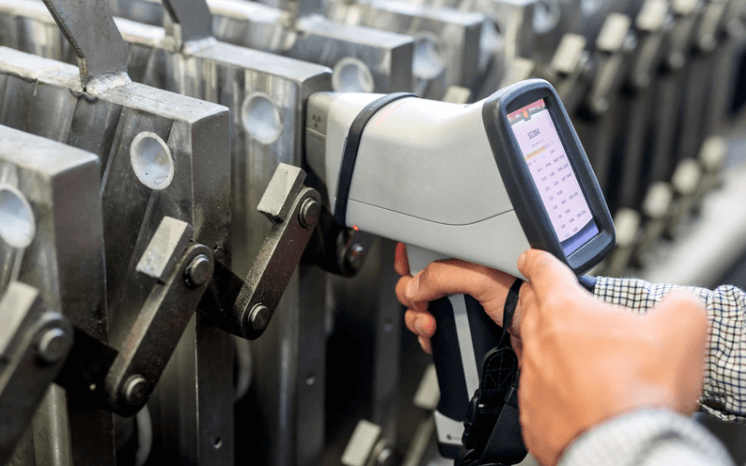
Handheld XRF (X-ray fluorescence) analyzers are versatile tools used in various industries for material identification and elemental analysis. These compact devices are particularly useful for their portability and ease of use. Here are some key applications:
- Alloy Identification: Determines the composition of metal alloys.
- Tramp Element Detection: Identifies unwanted elements in metal production.
- Geochemical Data: Provides information for mining and exploration.
- Precious Metals Analysis: Analyzes the purity and composition of gold, silver, and other valuable metals.
- Coating Weight and Plating Thickness: Measures the thickness of coatings to ensure they meet specifications.
While using handheld XRF analyzers, safety precautions should be taken. These devices emit a directed radiation beam during analysis, so it’s crucial to follow ALARA (As Low As Reasonably Achievable) principles by considering factors like time, distance, and shielding. Always avoid pointing the analyzer at a person or body part.
EDXRF vs. WDXRF
XRF technology can be broadly classified into two types: EDXRF and WDXRF. Each type has distinct features and applications:
Feature: Elemental Range
- EDXRF – Sodium (Na) to Uranium (U)
- WDXRF – Beryllium (Be) to Uranium (U)
Feature: Concentration Range
- EDXRF – 100% to parts per million (ppm)
- WDXRF – 100% to sub-ppm levels
Feature: Resolution
- EDXRF – Lower spectral resolution
- WDXRF – Higher spectral resolution
Feature: Application Fields
- EDXRF – Metallurgy, forensics, polymers, electronics, archaeology, environmental analysis, geology, mining
- WDXRF – Same as EDXRF, with more accurate and sensitive measurements
Both Energy Dispersive X-ray Fluorescence and Wavelength Dispersive X-ray Fluorescence play significant roles in industries requiring detailed elemental analysis and are chosen based on the specific requirements of the analysis task.
Micro-XRF Analysis
Micro-XRF works by focusing a small X-ray beam down to a few micrometers, which allows for the examination of very fine details and small areas of the sample. This method is especially useful in fields such as:
- Forensics: Examining residues or small particles at a crime scene.
- Archaeology: Analyzing pigment composition in ancient artifacts.
- Geology: Investigating mineral inclusions in rocks.
- Electronics: Assessing materials in microelectronics.

Spectral Resolution in XRF
Spectral resolution is a critical aspect of XRF analysis, as it determines the ability to distinguish between different elemental peaks in the XRF spectrum. Higher spectral resolution allows for more precise identification and quantification of elements present in a sample.
Two main types of XRF systems that address spectral resolution are Energy Dispersive XRF and Wavelength Dispersive XRF:
- EDXRF: This technique measures the energies of emitted X-rays directly from the sample and generates an XRF spectrum. EDXRF covers elements from sodium (Na) to uranium (U) and is suitable for a wide range of applications.
- WDXRF: This technology physically separates X-rays based on their wavelengths, providing higher spectral resolution compared to EDXRF. WDXRF can extend the measurable element range down to beryllium (Be) and offers spectral resolutions between 5 eV and 20 eV, making it ideal for applications requiring high precision.
Advanced XRF techniques, such as Micro-XRF analysis and high spectral resolution, significantly enhance the versatility and accuracy of XRF technology, making it an invaluable tool across scientific and industrial applications. By utilizing these innovations, practitioners can gather precise, detailed insights that drive better decision-making and improved outcomes. At Centers Urgent Care, we are committed to delivering fast, high-quality urgent care services in New York City for children and adults. If you’re searching for reliable urgent care, contact us today to learn how we can meet your healthcare needs with excellence and care!
Sources:
HOW I WAS CURED FROM HERPES VIRUS
I am writing this testimonial with immense gratitude and a renewed sense of hope in my heart. For years, I battled with the physical and emotional torment caused by the herpes virus. It felt like an unending struggle, until I discovered a remarkable solution that changed my life forever. Like many others, I had tried countless remedies, medications in search of a cure. I had lost hope, resigned to the belief that herpes was something I would have to live with indefinitely. However, fate intervened and led me to a breakthrough that altered the course of my life. Upon stumbling on a revolutionary treatment option, my skepticism slowly transformed into a flicker of hope. The treatment was a natural remedy from Dr Awase [ HERBS ] Over time, as I followed the treatment diligently, I started noticing positive changes and I experienced a boost in my overall well-being. I am ecstatic to share that I am now herpes-free confirmed by my Dr after a test was done. The treatment I received was nothing short of miraculous and I couldn’t be more grateful. I have regained my self-confidence and the burden that once weighed heavily upon me has been lifted. I was cured of my herpes virus through natural medication.
If you, like me, have been struggling with herpes and searching for a way out, please know that hope exists. May my story inspire hope in the hearts of those who need it. He also specializes in getting rid of HPV, OVARIAN CYST, PCOS, HEPATITIS and a lot more.
Contact on WhatsApp +2349074997110
Email:- dr.awaseherbalhome@gmail. com
2025 has changed my life. I never believed I would be cured by a spell caster who specializes in herbal cure and magical spells. I am talking about the help Doctor Odunga gave to me. I have been cured of herpes HPV which has plagued me for over 2 years. I am very happy to tell others that if you want to be cured or get your ex back spells and get pregnant naturally, even financial blessing through lottery, there is only one place to be and that is with Dr Odunga Spell Temple. Am so happy that just 3 days after taking DR ODUNGA Herbal treatments my herpes was cured permanently. DR ODUNGA also have cure to #HIV #Diabetes #Lupus #Tinnitus #Fibroid #Cancer #Hepatitis B, #Syphilis #Infertility etc … If you have this ailment or whatsoever you might be suffering from you should contact him at his EMAIL: odungaspelltemple@gmail.com OR VIA Whats App +2348167159012